Are You Offering Online Photo Editing at the Library?
Text transcript from the PDF text layer
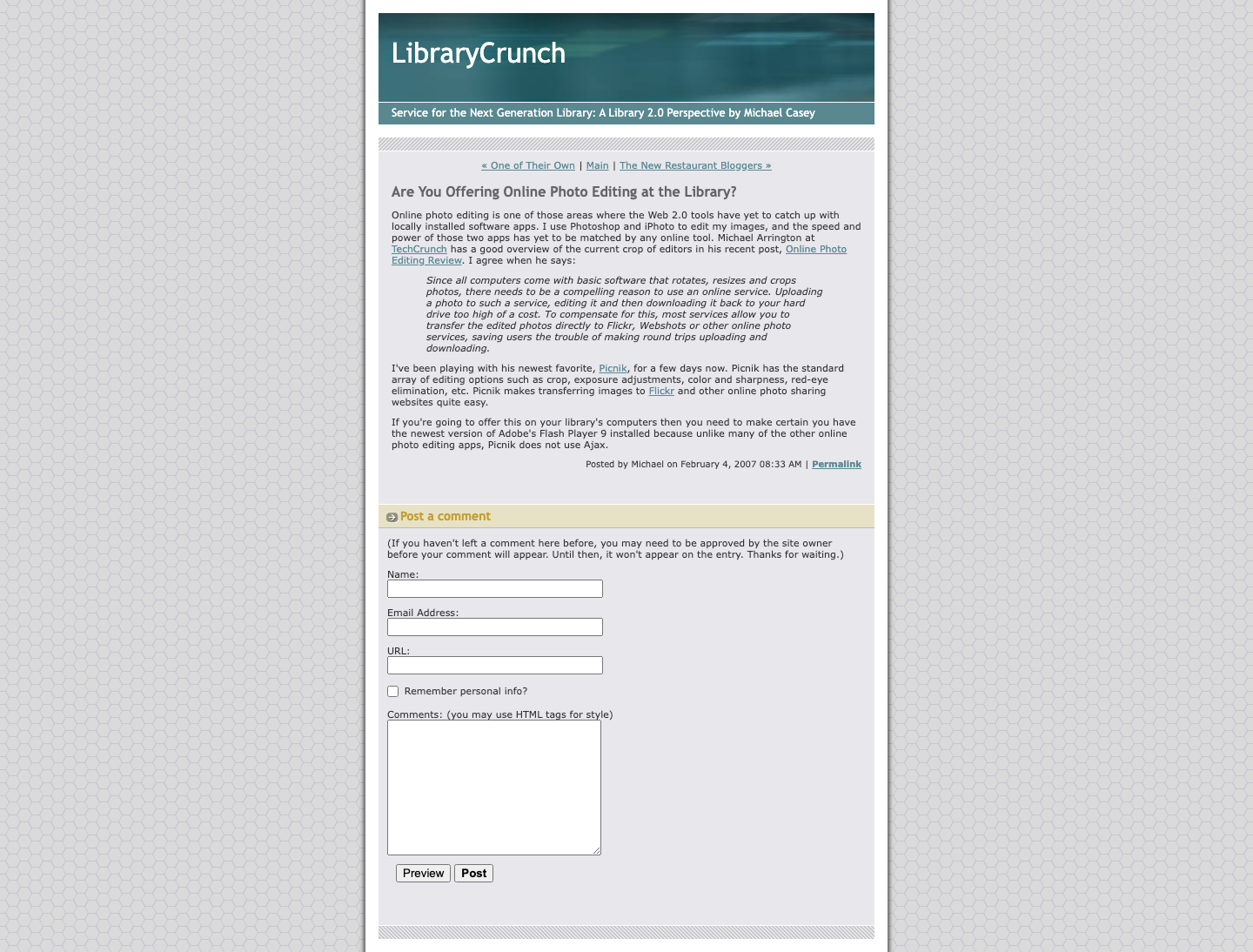
Online photo editing is one of those areas where the Web 2.0 tools have yet to catch up with locally installed software apps. I use Photoshop and iPhoto to edit my images, and the speed and power of those two apps has yet to be matched by any online tool. Michael Arrington at TechCrunch has a good overview of the current crop of editors in his recent post, Online Photo Editing Review. I agree when he says: Since all computers come with basic software that rotates, resizes and crops photos, there needs to be a compelling reason to use an online service. Uploading a photo to such a service, editing it and then downloading it back to your hard drive too high of a cost. To compensate for this, most services allow you to transfer the edited photos directly to Flickr, Webshots or other online photo services, saving users the trouble of making round trips uploading and downloading. I've been playing with his newest favorite, Picnik, for a few days now. Picnik has the standard array of editing options such as crop, exposure adjustments, color and sharpness, red-eye elimination, etc. Picnik makes transferring images to Flickr and other online photo sharing websites quite easy. If you're going to offer this on your library's computers then you need to make certain you have the newest version of Adobe's Flash Player 9 installed because unlike many of the other online photo editing apps, Picnik does not use Ajax.
Captured from http://www.librarycrunch.com:80/2007/02/are_you_offering_online_photo.html via the Internet Archive Wayback Machine. The screenshot and PDF preserve the captured visual layout; the transcript is provided for search and accessibility.